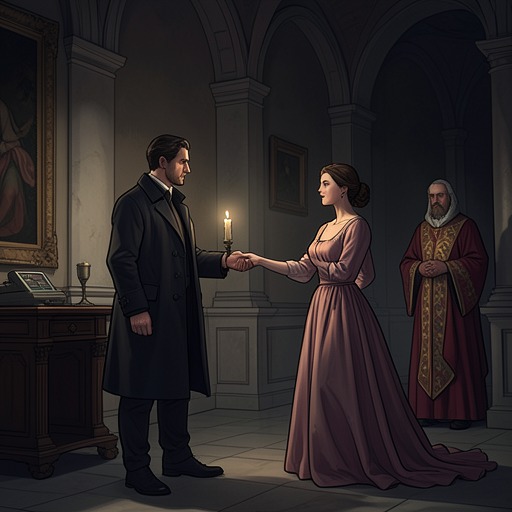
Frederic–Matilda Marriage Arrangement
The Castle of OtrantoFrederic’s proposed marriage to Matilda is an unstable dynastic bargain: Hippolita advances it to avert conflict between rival houses, Manfred incorporates it into a double-marriage scheme that would also make Isabella his wife, and Frederic’s attraction to Matilda makes him receptive. A supernatural command to forget Matilda breaks the arrangement before it can be fulfilled. Its failure leaves the prospective marriages entangled with the struggle for Otranto’s succession, but the final change in the recognized heir makes the alliance unnecessary.
Background and Political Stakes
The proposal grows out of a succession dispute. Frederic’s ancestors had claimed the title of Princes of Otranto after Alfonso the Good died without issue, but Manfred’s family had been too powerful for the house of Vicenza to displace. Manfred had arranged for his son Conrad to marry Frederic’s daughter Isabella, hoping to join the claims of the two houses through that match. After Conrad dies, Manfred proposes to marry Isabella himself, preserving his plan to secure male heirs and, as he hopes, the principality.
Hippolita’s Proposal
After Frederic arrives to reclaim Isabella, Hippolita concludes that the ominous events of the preceding days mean that heaven intends Otranto’s sceptre to pass from Manfred to Frederic. She proposes Matilda to the Marquis as a way to avert the destruction of her household by joining the rival houses. Her offer is not presented as Matilda’s own choice: Hippolita tells Isabella and her daughter that she has discussed the proposal with Manfred, who received it favorably and has gone to make it to Frederic. Matilda’s startled response makes clear that she had not expected her mother to arrange such a match.
Hippolita seeks Jerome’s counsel about the proposal and about her willingness not to oppose the separation it would entail. Jerome distrusts the plan. He argues that Frederic, who has come as the nearest blood claimant to Alfonso and to claim his succession, is unlikely to ally himself with the usurper of his right. Rather than disclose his dislike of Manfred’s proposed marriage to Isabella, he emphasizes the sinfulness of Hippolita’s consent to a divorce and warns her against accepting that proposition.
Manfred’s Double-Marriage Bargain
Manfred presents the arrangement to Frederic as a double marriage: Matilda would marry Frederic, while Manfred would marry Isabella. Frederic is drawn to the proposal because he has been struck by Matilda’s beauty. He also reasons politically: seeing little prospect of removing Manfred by force, he hopes that his own succession might be made easier if Matilda and Manfred have no children. His resistance is therefore limited; he makes only a formal objection that he will not agree unless Hippolita consents to the divorce, leaving Manfred to obtain that consent.
The offer consequently makes Matilda’s marriage part of a wider exchange over succession and household authority. Manfred treats his marriage to Isabella as a condition of granting Matilda to Frederic, while Frederic sees the proposed union as a possible route to his claim. The arrangement’s political logic depends on marriages and prospective heirs, not merely on the private inclination of either intended spouse.
Frederic’s Change of Course
Frederic’s attraction to Matilda intensifies after his arrival. At the castle, Theodore follows Matilda under the pretext of being relieved that Frederic survived their combat; Isabella observes their exchanged glances and recognizes that Matilda is the person Theodore loves. Later, during a banquet, Manfred seats Frederic beside Matilda. Frederic watches her with increasing passion, while Manfred presses him with wine and pursues the marriage proposal. After the feast, Frederic seeks Hippolita, believing she may be prepared to accept the divorce and hoping to encourage her acquiescence. His attention to Matilda has displaced the portents that had previously alarmed him.
In Hippolita’s oratory, Frederic encounters an apparition that recalls the buried sabre and heaven’s command engraved upon it. The spirit’s instruction is to forget Matilda. Frederic responds with penitence and distress; when Hippolita enters, he is still overcome and cannot immediately explain himself. The warning thus interrupts the planned alliance at the moment Frederic is pursuing Hippolita’s consent, turning a political and romantic prospect into a forbidden course he is commanded to abandon.
Failure and Aftermath
The marriage arrangement is never completed. Matilda dies, and the supernatural vision seen by the company reinforces Manfred’s understanding that he faces expulsion. Jerome’s account then clarifies the family history: Matilda was the daughter born to Victoria and was given in marriage to Jerome when she reached maturity; Victoria died, and the secret remained hidden. Theodore’s account had already supplied the rest of the revelation. With the succession transformed by the disclosure of Theodore’s lineage, Frederic offers Isabella to the new Prince, rather than continuing the proposed match between himself and Matilda.
Even that later offer does not immediately create a new marriage. Theodore’s grief for Matilda is too fresh for him to contemplate another love. Only after repeated conversations with Isabella about Matilda does he accept that he may find happiness in Isabella’s company, where he can continue to cherish his grief. The unrealized Frederic–Matilda arrangement therefore ends twice over: first when the apparition tells Frederic to relinquish Matilda, and finally when Matilda’s death and Theodore’s revealed place in the succession make the original dynastic bargain impossible and obsolete.